
What is Ancillary Revenue?
Income generated from anything other than selling tickets (“non-ticket revenues”), i.e. ancillary services. In the previous decade, airlines have substantially enhanced their ancillary revenues by adopting two key strategies: unbundling and introducing innovative products (Ceregeiro, 2021; Materna & Tomová, 2016; Silva de Mattos et al., 2022). It allows airlines to offer lower and more competitive base fares and generate more revenue from the combination of tickets and ancillary services. Well known “extras” are additional baggage (cabin and checked), seat selection (more legroom), priority boarding, hotel reservations and car rentals.
How Important is Ancillary Revenue for Airlines?
More and more important. Ancillary revenue has transformed into a key focus area for airlines. For many low-cost carriers more than 50% of revenue comes from ancillary services. In 2023, airline ancillary revenue increased to $117.9 billion worldwide. Ancillary revenue accounted for 14.7% of total airline revenue in 2023 (compared to 6.0% in 2013). They represent an invaluable revenue stream in an industry characterized by tight margins and intense competition. Without ancillary revenue, the industry would not be profitable.
Driving Forces Behind Growth
Rise of LCCs and ULCCs
Budget airlines revolutionized the industry with their low base fares and have generated profit through additional services. This has led to the unbundling of airline products across the industry.
Easier Distribution of Ancillaries
With airlines prioritizing direct distribution channels, selling ancillaries has become more streamlined. The introduction and evolution of NDC has further reduced friction in distributing ancillary services.
A Shift in Consumer Mindsets
Consumer attitudes have changed as modern travelers are more willing to pay for ancillary products. They have become accustomed to, and even expect, the ability to customize their travel experience.
Categories of Ancillary Services
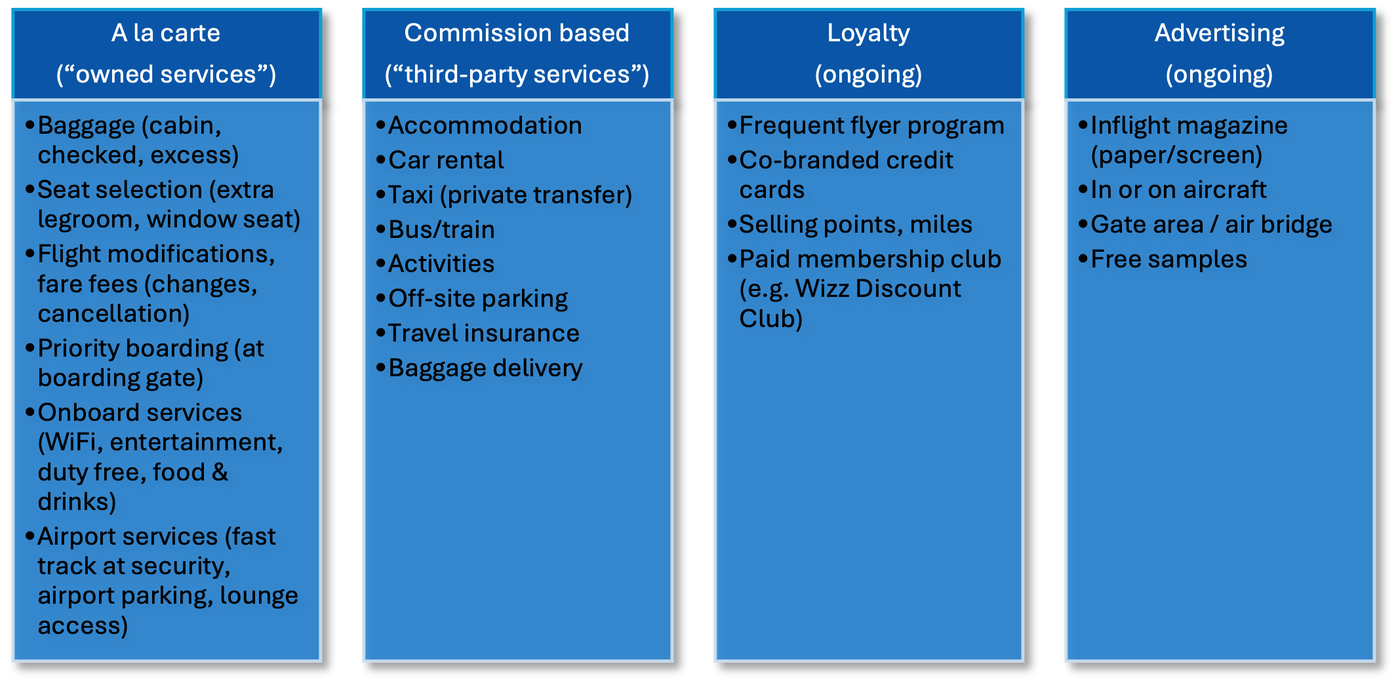
Ancillary services offered by airlines are often lumped together, even though there are differences. For customers it is easier to talk about ancillary services, for professionals however it is important to make a distinction. As seen below, ancillary services can be divided into four categories.
Baggage and Seat Selection Most Profitable
Bags, seats, fare bundles and fare fees are the most profitable ancillary services for airlines, according to Statista. These services are owned by the airline and have the highest margin. Revenue through commission based third-party services is less profitable, because the revenue is shared with partners. Next to this, conversion is lower and competition is fierce.
Bundling the Unbundled (Fare Bundles)
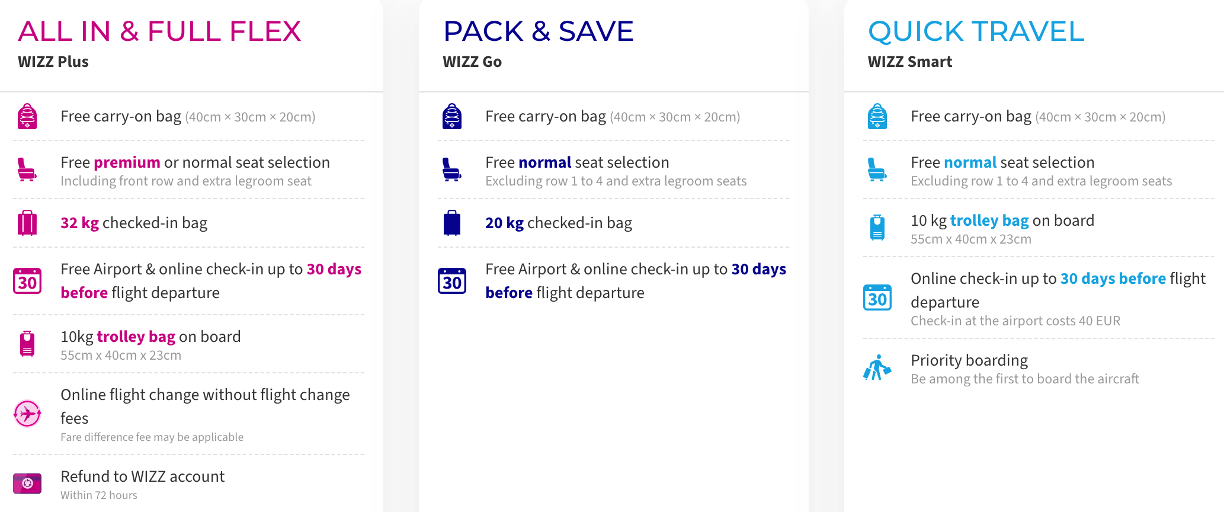
In the current era of air travel, passengers have the option to book a plane ticket with basic or light features, omitting extras. Yet, selecting individual extras isn’t always required. Most airlines provide bundled packages, typically ranging from budget-friendly to pricier and flexible options. While airlines present these choices as advantageous, it may not always be in the passenger’s best interest to opt for one. Nevertheless, for the airline, it serves as a clever method to boost additional revenue.
Future Looks Bright
The future looks bright for airlines. Most analysts foresee a bright future for ancillary revenues. According to OAG, experts suggest that growth in this sector is far from slowing down. Rather, the industry can anticipate a double-digit expansion over the next few years, solidifying the critical role of ancillaries in airlines’ revenue streams. This continued growth underscores the importance for airlines to strategically invest in, and optimize, their ancillary offerings. There are great opportunities for traditional airlines in particular, as low-cost carriers already have a high dependency on ancillary revenue.
- https://www.oag.com/blog/shaping-airline-retail-unstoppable-rise-ancillaries · 13 June 2023
- https://corporate.cartrawler.com/news-resources/reports-insights/ancillary-revenue/the-2023-cartrawler-yearbook-of-ancillary-revenue/ · 21 September 2023
- https://www.mckinsey.com/industries/travel-logistics-and-infrastructure/our-insights/the-six-secrets-of-profitable-airlines · 28 June 2022
- https://skift.com/2022/08/04/5-tips-for-unlocking-ancillary-revenue-throughout-the-traveler-journey/ · 4 August 2022
- https://simpleflying.com/airline-ancillary-revenue-projection-2023/
- https://www.statista.com/statistics/1100397/top-ancillary-products-in-airline-travel-worldwide/
- https://www.tandfonline.com/doi/full/10.1080/23311975.2024.2322018
Ready to add the ground transportation layer?
Let's talk about how Ancillary Revenue Booster fits into your booking flow and your email journey.